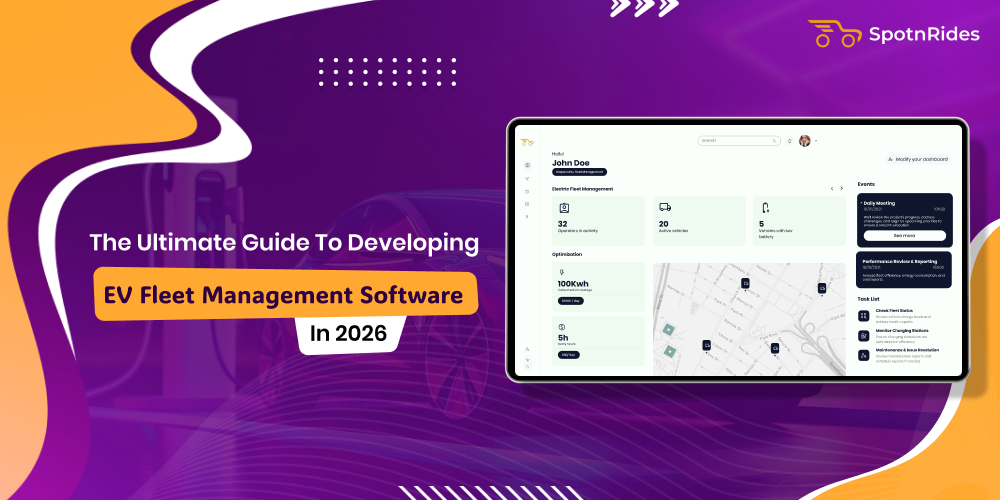
The Ultimate Guide to Developing EV Fleet Management Software in 2026
EV fleets are not designed for the future but are gradually consuming the mainstream. Ride-sharing businesses that have invested in EV fleets should realize that 2026 is the right year to launch the service with ready-made EV fleet management software. Developing a next-gen EV fleet management system helps you optimize charging schedules and enhance resource utilization.
Considered a powerhouse for corporate EV fleets, European countries are continuously expanding their presence in the market. EV transition is also noticeably higher in the Latin American countries. From managing battery health to predictive maintenance, the digital solution transforms ride-hailing and ride-sharing fleet operations. Discover through the blog to find the complete steps to develop an EV fleet management software in 2026.
What is an EV Fleet Management Software
EV fleet management software is a digital platform that helps businesses monitor and optimize the performance of electric fleets. Fleet operators can use the complete platform with real-time data and control, route planning, and smart charging optimization to maximize EV fleet utilization. Advanced tools integrate into the EV fleet management solution for better fleet diagnostics, route optimization, and charging controls.
The major types of EV fleet management software solutions include:
- Telematics & Fleet tracking apps: The all-in-one EV fleet telematics solution comes with vehicle diagnostics, location monitoring, and charging status checks for optimized route planning.
- Charging management system: The system helps ensure the vehicles are fully charged before dispatch and optimizes charging schedules for better management.
- Route optimization apps: Through multi-stop routes and AI systems, they improve energy efficiency and increase the number of trips per day.
- Battery monitoring apps: The EV fleet software reduces the possibilities for breakdowns and helps track battery health and real-time performance.
- EV fleet management solution for taxi fleets:
- White-label EV fleet apps: Launch your customizable apps for EV fleet management faster and elevate your brand in the digital space.
The Current Market Size & Future Trends of EV Vehicles
Taxi businesses use global sustainability objectives to secure investor capital. Giants in the field commit to achieving a zero-emission fleet by 2040. Thus, they are transitioning to expand their EV fleets in the near future. The need for driving partners to shift toward electric models has risen, and it is noticeable from trends such as green options for riders. Mordor Intelligence estimates the EV taxi market size to reach USD 36.81 billion.
The growth trajectory is forecasted from the 2025 value of USD 29.54 billion to the 2031 value of USD 110.56 billion at a CAGR of 24.6%. When we segment the market by service model, ride-hailing apps will consume 72.88% share of the EV taxi market in 2025.
- The eclectic vehicles are currently used the most in ride-hailing, ride-sharing, corporate fleets, and airport and tourism shuttles.
- Corporate fleets are slowly replacing the traditional independent driver models to ensure enhanced charging logistics and improved service reliability.
- Leasing models are improving, and the driver incomes from EV taxis are becoming stable. So, taxi business owners are increasing their investment in EV fleets.
How Developing an EV Fleet Management Software Empowers Taxi Businesses
Ride-hailing startups receive tremendous advantages from using a ready-made EV fleet management software. The advanced system helps business owners embrace unmatched flexibility and efficiency in their operations. Unlike traditional apps, these solutions enable entrepreneurs to monitor vehicle telematics, battery state-of-charge, and maintenance.
Intelligent Range Management
The EV fleet management system helps with dynamically predicting, tracking, and optimizing battery range to maximize vehicle uptime and prevent breakdowns during the middle of the trip. Predicting the actual range per vehicle eliminates range anxiety for riders and drivers.
Route Optimization for Resource Efficiency
Driving partners can utilize the smart routing in the digital platform to take the most energy-efficient paths and reach customers on time. For quick pickups, they can detect real-time traffic and elevation changes on the smartphone and then change routes.
Smart Charging Optimization
Taxi businesses can manage their charging schedules and locate fast chargers to lower electricity costs and reduce vehicle downtime. Through real-time data such as utility rates and route demands, businesses can optimize energy management and drive efficiency.
Predictive Battery Maintenance
The EV fleet management software predicts degradation and detects anomalies in advance. Hence, EV fleet owners can prevent sudden downtime and premature battery replacements. Before severe range loss, they receive early alerts on the natural degradation rate.
Improved Safety Compliance
Green fleet compliance is gaining momentum among the mobility businesses. The software for EV fleet management integrates safety functionalities such as diagnostics, predictive maintenance, and compliance alerts to help meet the regulatory standards.
Data-Driven Business Moves
The system converts raw telematics and charging data into actionable insights. Fleet managers can use the real-time analytics and the dashboards to monitor battery health, optimize routes, and ensure sustainability compliance through smart decision-making.
Essential Features To Include In an EV Fleet Management Software
A future-ready EV fleet management software is developed with the right suite of essential and advanced features. These functionalities help manage EV vehicles, optimize battery usage, and offer operational efficiency.
Real-Time Fleet Tracking
Real-time fleet tracking provides fleet managers with live GPS-based visibility into every vehicle’s current location, speed, route adherence, and status. Managers can instantly reroute a low-battery vehicle to a charging station from a single dashboard.
Predictive Maintenance Alerts
For electric vehicles, this app includes battery health degradation tracking, thermal management warnings, and charging component wear. It integrates intelligent maintenance scheduling with automated alerts dispatched to both fleet managers and drivers.
Smart Routing System
The feature accounts for real-time battery levels, charging station availability along the route, traffic conditions, payload weight, and driver shift constraints. The dynamic routing system factors in charge levels and station proximity as first-class routing parameters.
EV Fleet Dispatch
Electric fleet management systems help maintain proper departure times and thus increase rides. The intelligent dispatch module matches vehicles to jobs based on current charge level, vehicle range, driver availability, and job urgency.
IoT Integration
IoT sensors embedded in vehicles continuously transmit data on battery temperature, charging cycles, motor performance, tire pressure, and cabin conditions. The feature allows businesses to connect a wide range of EV telematics hardware without vendor lock-in.
Charging Station Finder
The locator feature shows drivers the nearest compatible charger, its current availability, charging speed, and the time they likely take to reach. Advanced implementations also allow for reservation and remote charging session initiation.
Push Notification
Push notifications keep drivers informed of dispatch assignments, charging reminders, route changes, and maintenance alerts, while keeping fleet managers updated on vehicle status changes, geofence breaches, and critical alerts in real time.
Integrated Payments
Integrated payments in the Ev fleet management app eliminate the fragmentation of managing billing outside the platform and reduce administrative overhead. Hence, it creates a complete financial audit trail for compliance and reporting purposes.
Driver Behavior Monitoring
Monitoring metrics such as harsh acceleration, aggressive braking, excessive idling, speeding, and cornering allows fleet managers to identify high-consumption drivers and deliver targeted coaching.
Real-Time Analytics
A powerful real-time analytics dashboard transforms raw telemetry into actionable business intelligence. Thus, it helps visualize fleet utilization rates, energy consumption trends, cost per mile, charging efficiency, driver performance rankings, and sustainability metrics.
How Can You Develop EV Fleet Management Software in 2026
Building a custom EV fleet management platform in 2026 is a strategic investment with a clear, structured pathway. Here is the development lifecycle.
Step 1: Define Your Fleet Capacity and Use Case
Identify whether you are managing a last-mile delivery fleet, a corporate ride-sharing service, a public transit operation, or a logistics network. Each use case shapes the feature priority, vehicle compatibility requirements, and integration stack.
Step 2: Choose Your Technology Stack
Modern fleet management systems for EVs are built on cloud-native architectures (AWS, Azure, or GCP), use real-time data pipelines, and deploy mobile apps for both iOS and Android. AI and machine learning modules power the predictive and optimization layers, while IoT middleware connects hardware devices to the software layer.
Step 3: Develop or Buy The Core Modules
Decide which components to develop in-house versus leverage through a white-label platform provider. Core modules include fleet tracking, dispatch, maintenance, charging management, driver app, and analytics. Building from scratch takes 12–18 months and a significant budget; white-label platforms like SpotnRides can compress that to weeks.
Step 4: Integrate Third-Party APIs
Connect your telematics devices, charging network APIs (OCPP-compatible chargers), mapping services, and payment gateways. Hardware-agnostic platforms deliver the greatest flexibility here.
Step 5: Test, Deploy, and Scale
Conduct rigorous QA across vehicle types, network conditions, and edge cases (low battery scenarios, network outages, concurrent dispatch). Deploy to a pilot fleet before full rollout, and choose a platform that scales data management and infrastructure alongside fleet growth.
Step 6: Continuous Improvement
The best EV fleet platforms are regularly updated with new tools and features, helping businesses stay ahead of regulations, technology changes, and customer expectations. Partner with a provider committed to ongoing development.
Why Choosing The Right Platform Provider Matters
As a fully customizable, white-label EV fleet management software development platform, SpotnRides delivers:
- Speed to market: launch your branded EV fleet management platform in weeks, not years
- Full customization: every feature, workflow, and interface tailored to your business
- White-label branding: your identity, your product, your competitive moat
- Multi-format adaptability: deployable across taxi, logistics, corporate mobility, and delivery use cases
- Cost-effective development: a fraction of the cost of a ground-up build
- Ongoing support: a development partner, not just a software vendor
SpotnRides has been building fleet management solutions since 2017. Their platform has enabled multiple businesses to reduce lead time, improve demand forecasting, optimize fleet routes, and scale operations, now extended natively to the EV era.
For entrepreneurs, fleet operators, and enterprises that want to lead in the EV mobility space rather than rent capacity on someone else’s platform, SpotnRides is the definitive choice.
Conclusion
A successful EV fleet management software must deliver real-time fleet tracking, predictive maintenance, smart EV-aware routing, intelligent dispatch, deep IoT integration, seamless charging station management, timely push notifications, integrated payments, driver behavior analytics, and a powerful real-time analytics engine.
Of all the paths to building such a platform, partnering with SpotnRides offers the most compelling combination of speed, customization, cost-efficiency, and EV-native capability. It is not just a software vendor; it is the strategic platform partner for the electric fleet future.
FAQ
EV fleet management software is a digital platform designed to manage electric vehicle fleets, covering real-time tracking, battery monitoring, charging management, route optimization, driver behavior analytics, and operational reporting — all within a single unified system
Traditional fleet management was built for internal combustion engines, focusing on fuel consumption and standard maintenance schedules. EV fleet management adds battery state-of-charge monitoring, charging station integration, range-dependent routing, depot charging optimization, and energy cost management, capabilities that legacy platforms cannot deliver natively.
Building from scratch typically takes over years. Partnering with a white-label platform provider like SpotnRides can reduce that timeline to weeks by providing a pre-built, fully customizable foundation.
Absolutely. Real-time analytics enables fleet managers to track energy consumption, cost per mile, driver performance, and sustainability metrics continuously. It enables data-driven decisions that improve efficiency, reduce costs, and support ESG reporting requirements.
About the author

Comments are closed.