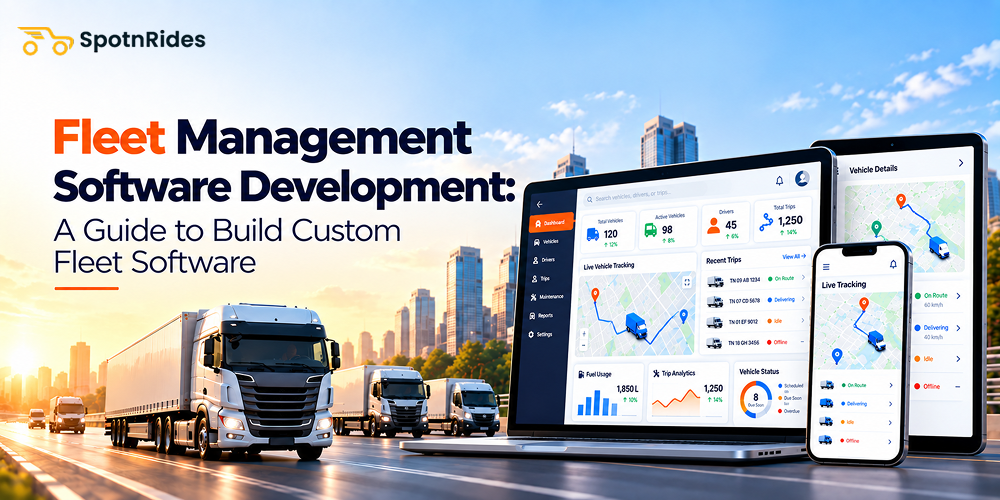
Fleet Management Software Development: A Guide to Build Custom Fleet Software
Managing a fleet is more than tracking a vehicle. Businesses need to manage several activities such as coordinating with drivers, monitoring vehicle health and fuel usage, handling maintenance, and more. Handling these processes manually is time-consuming. It might also lead to delays, high operational costs, and poor visibility.
To overcome all these issues, fleet management software is the one-stop solution. A custom fleet management solution brings fleet operations to one platform, therefore allowing businesses to track vehicles, manage drivers, automate routine tasks, and make faster decisions using real-time data.
If you’re a business owner managing deliveries, vehicles, and transportation operations, real-time visibility can make all the difference. This guide explains how to build custom fleet management software to streamline your operations.
Before seeking in depth, let’s get to know the basics.
What is Fleet Management Software Development?
Fleet management software development is the process of creating a digital platform supporting businesses to manage vehicles, drivers, routes, maintenance, and fleet operations. All these processes are done from one centralized system.
Unlike a ready-made solution, custom fleet software is designed based on the company’s specific workflow. The software can also connect with GPS devices, telematics systems, ERP platforms, fuel cards, payment systems, and other business tools.
A custom solution can include:
- Vehicle and GPS tracking
- Driver management
- Route planning
- Maintenance scheduling
- Fuel monitoring
- Compliance management
- Real-time alerts
- Fleet analytics
- Mobile applications
- Third-party integrations
This makes the software suitable for transportation providers, rental companies, logistics companies, and other organizations operating commercial fleets.
Top Reasons Why Businesses Need Custom Fleet Management Software
The main reason for businesses choosing custom fleet software is flexibility. A traditional fleet management software system can provide useful features but cannot help with every operational requirement.
Custom development allows businesses to build software around their processes instead of changing their processes to fit the existing software.
Better Operational Visibility
A centralized dashboard can show vehicle locations, driver activity, trip status, maintenance schedules, and other information in real time. This information is used by the fleet managers to identify delays and respond quickly.
Automated Fleet Operations
Routine tasks such as maintenance reminders, driver notifications, inspection records, and reports can be automated. This minimizes the manual work and helps employees to focus on their high-value activities.
Flexible Integrations
The custom fleet software can connect with existing applications such as ERP, CRM, accounting, GPS, telematics, and others. This creates a connected technology instead of different tools for different functions.
Scalable Architecture
As the business grows, the software can be expanded with new vehicles, users, integrations, and features without replacing the entire platform.
CTA: Ready to modernize your fleet? Click here to explore how developing EV fleet Management software in 2026 can help you build a smarter, more connected EV fleet.
Core Features of Fleet Management Software Development
The right features in a fleet management software development solution depend on the fleet’s size and business model. There are several functionalities vital for a custom fleet management platform. Let’s discuss some.
- Real-Time GPS Tracking
GPS tracking provides real-time information about vehicle locations and trip progress. Fleet managers can view vehicles on a map, monitor routes, and identify delays. Moreover, geofencing can also trigger alerts when vehicles enter or leave predefined locations.
- Driver Management
The driver management module can store data related to drivers such as their profiles, assignments, performance, and other documents. With this data, businesses can identify drivers’ speeding, braking, idling, and other patterns.
- Vehicle Maintenance Management
The vehicle maintenance feature helps businesses to schedule inspections and servicing based on the vehicle’s health, such as mileage, usage, time, and condition. The application can send automatic reminders and maintain digital service histories. This helps businesses to reduce unexpected downtime and keep vehicles available for operations.
- Route Optimization
Route optimization helps dispatchers select efficient routes based on factors such as traffic, vehicle availability, delivery schedules, and road conditions. For every delivery business, dynamic route planning is a significant feature helping to respond to changing conditions during a trip.
- Fuel Management
Fuel management provides visibility into consumption, expenses, and vehicle efficiency. Businesses can compare fuel usage across vehicles and identify unusual patterns. For companies moving toward electric vehicles, the platform can also be extended to monitor battery levels, charging activity, and locations.
- Alerts and Notifications
Automated alerts keep fleet teams informed about important events. Notifications can be triggered for maintenance requirements, route deviations, speeding, low fuel, vehicle faults, or delayed trips.
- Analytics and Reporting
Fleet analytics turn operational data into useful business insights. Custom dashboards can display metrics related to vehicle utilization, fuel consumption, maintenance, driver performance, trip efficiency, and operating costs.
Key Steps to Build a Fleet Management Software
Every successful project needs a structured development process. The following steps can help businesses move from an idea to a production-ready solution.
Define Business Requirements
Before entering into the project development, we first analyze the problems. Consider fleet size, vehicle type, operational flows, compliance, and existing systems. Prioritize features based on business value rather than trying to build everything at the same time.
Plan the UI/UX
Our team designs separate UI/UX for fleet managers, dispatchers, drivers, maintenance teams, and admins. The interface should help to find important information easily to make quick decisions.
Select Right Tech Stack
Selecting the right technologies is important, and it should support real-time data, integrations, security, and future growth. A typical application should include a cloud backend, web dashboard, mobile applications, APIs, GPS service, and telematics integrations.
Build the MVP
We first help businesses to start with the core features to operate a fleet. An MVP includes GPS tracking, vehicle management, driver management, trip management, and basic reporting. Launching an MVP allows businesses to collect user feedback before expanding the platform.
Integrate Third-Party Systems
Connect the platform with the tools already used by the business. Depending on the operation, integrations include GPS providers, telematics devices, mapping services, ERP systems, fuel systems, or compliance solutions.
Test and Deploy
Once the application is developed with all necessary integrations, the application should be tested for performance, security, usability, API reliability, and real-time data accuracy. After testing, the system can be deployed and introduced to users via structured testing.
Improve Continuously
Fleet operations change as businesses grow. Post-launch development can introduce advanced analytics, AI-based recommendations, predictive maintenance, EV management, automation, and additional integrations.
How Much Does Fleet Management Software Development Cost?
The cost to develop fleet management software depends on several factors such as feature selection, project complexity, third-party integration, tech stack, and others. The basic MVP with vehicle tracking, driver management, trip management, and reporting requires less development effort than an enterprise platform with IoT integrations and AI capabilities. Some key factors affecting the development cost are:
- Web and mobile application requirements
- GPS and telematics integrations
- Third-party API costs
- AI and analytics requirements
- Security and compliance needs
- Cloud infrastructure
Wrapping Up
Fleet management software development supports businesses in creating a platform around their actual fleet operations. Instead of depending on disconnected tools, companies can bring all activities like tracking, maintenance, analytics, and more into one system. The best approach is to begin with a clear business idea and requirements. If you are planning to build custom fleet management software, partner with SpotnRides, the premier fleet management software development company helping businesses to transform fleet workflows into a scalable digital solution supporting visibility, automation, and long-term growth.
FAQ
Companies caters to logistics or vehicle fleets can benefit from this software. They can manage and track drivers’ performance, location, fuel usage, and others.
The fleet management software development cost is based on the project’s features, complexity, business model, third-party integration, and others.
Yes, fleet management software can integrate existing tools such as ERP, SAP, and other systems.
About the author

Comments are closed.