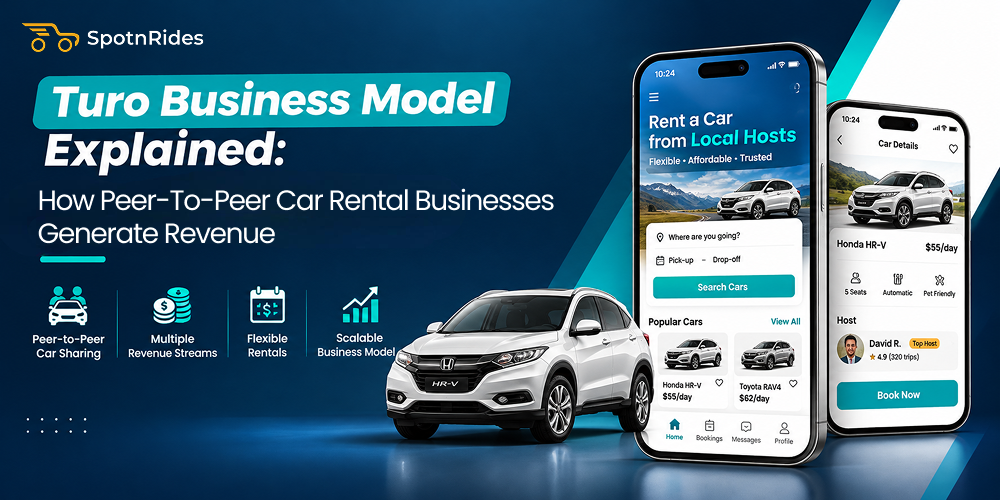
Turo Business Model Explained: How Peer-to-Peer Car Rental Businesses Generate Revenue
Traditional car rental industry is primarily characterized by its company-owned vehicles, fleet management, and physical car rental outlets. But the peer-to-peer car rental service has come up with a different idea. It enables individual car owners to rent out their vehicles through online platforms.
The best example of this business model is Turo. It bridges the gap between car owners and those seeking hassle-free rental deals. The platform does not have to keep an extensive fleet, but it provides a marketplace where independent hosts supply vehicles and guests book them. Turo makes an interesting example for entrepreneurs and car rental companies to consider, as technology can make renting a car a whole lot easier while also providing a variety of revenue streams.
Let’s explore how the Turo business model works and generates income.
What Is Turo’s Business Model?
Turo follows a peer-to-peer car-sharing business model. It links the car owners to car rental service providers. Moreover, serves as an intermediary by enabling the digital infrastructure needed to manage the listing of vehicles, payments, bookings and services related to the renting of those vehicles. It is different than the traditional rental firms, which own and maintain their own fleet of vehicles. Turo uses cars from private owners. Its business model creates value for 3 major stakeholders:
Hosts: People and fleet operators make money from providing vehicles for rent.
The visitors: Customers can browse the different types of vehicles and choose to rent a car according to their budgets and needs.
Platform Owner: They can make money from bookings and offering supplemental services
It is a clear structure that assists business owners to enter the car sharing industry without staking their company on stocking vehicles.
How Does Turo Work?
Knowing the operational flow of a business helps companies to identify the key processes needed for starting a similar business.
Host Registration and Vehicle Listing
Vehicle owners register on the platform and complete the necessary verification process so that they can rent. They provide vehicle details, availability, rental rates, pictures, and other relevant information. Upon approval, they can put their cars up for rent.
Vehicle Search and Booking
Guest create account and provide the necessary details like preferred location and rental dates. They can browse vehicles filter based on vehicle category, fuel type and other preferences. After finalizing the vehicle, they can view the fare details and confirm the booking.
Payment and Booking Confirmation
After the booking is confirmed, the platform processes the guest’s payment and updates it to the booking status. The necessary reservation information is sent to the hosts who then prepare the vehicle for the next day’s rental.
Vehicle Pickup and Return
Vehicles are available for guests to pick up from certain places, or they can choose their preferred delivery locations. Additionally, vehicle condition prior to and after the rental period is documented, which aids in accountability between both parties.
Payout and Reviews
Once the travel is completed, the platform’s earnings are passed on to the hosts according to its payout rules. Feedback can be provided by both parties, which can help ensure the quality of the service and trust.
How Does Turo Make Money? 6 Major Revenue Streams
There are numerous monetization techniques to generate revenue. The following are the most common streams entrepreneurs prefer.
1. Booking and Service Charges
Booking charges constitute a key revenue generating opportunity. They include service charges collected from the hosts, guests, or both according to the pricing structure of the platform. Such charges are calculated in relation to the rental amount and other factors. For a new business, the presence of the pricing structure facilitates the generation of recurring revenue from completed transactions.
2. Host Commission
The platform can collect a certain percentage of commission from the rental income of the host. In other words, when the vehicle is booked, the platform charges certain amount and the rest of the amount to the host. This strategy enables businesses to generate revenue from bookings without purchasing every vehicle on the platform.
3. Delivery and Convenience Charges
Customers prefer vehicles delivered to airports, hotels, workplaces, or other locations. Hence, the car-sharing platform can help to provide such services and collect certain charges depending on the distance or location among others.
4. Additional Usage and Violation Fees
Rental agreements may include additional charges for specific situations, such as late returns, excess mileage, cleaning requirements, or policy violations. The platform can facilitate these transactions through its payment system, following clearly defined policies and applicable local regulations.
5. Protection and Insurance-Related Services
Protection of the vehicle is an important consideration in peer-to-peer rentals. Platforms can work with authorized insurance providers to provide eligible protection options to hosts and renters. Based on the business arrangements and regulations, the platform may generate revenue via permitted service or partner arrangements.
6. Premium Services
A car-sharing platform can introduce optional premium services to increase earning potential. Some examples are enhanced vehicle visibility, featured listings, advanced host management tools, and premium booking convenience. These services create additional monetization opportunities beyond standard rental transactions.
What Makes Turo’s Business Model Attractive to Entrepreneurs?
Turo offers a number of business benefits that entrepreneurs should take into account when deciding to get into the car-sharing industry.
Asset-light operations: The platform expands by adding vehicles from third parties instead of buying a whole fleet.
Diverse revenue streams: Commissions, fees, and additional services provide multiple income streams.
Scalable operations: A central digital system can accommodate additional hosts, cars, and reservations as the business expands.
Flexible vehicles: A variety of vehicle types ensures that the right people are renting the cars.
Technology-based management: Digital booking, payment processing, verification, and communication reduce manual coordination.
The success depends on managing insurance arrangements, vehicle eligibility, local regulations, customer disputes, and marketplace trust.
How to Build a Peer-to-Peer Car Rental Platform Like Turo?
Building a dependable digital platform is a crucial factor for entrepreneurs intending to get into this market.
Following are the key elements for a successful Turo clone solution:
Customer App: Enables renters to register, find cars to rent, compare rental details, book, pay and interact with hosts.
Host App: This app allows vehicle owners to register, list vehicles, update availability, set pricing, make bookings and track earnings.
Admin Dashboard: Provides a unified dashboard to manage user verification, vehicle approvals, commissions, bookings, payments, disputes, and platform performance.
Real-time notifications, secure payment integration, location-based vehicle discovery, reviews, and analytics are additional functions that can enhance the efficiency of operations.
The technology should also be flexible enough for customization; this means that businesses will be able to set their own pricing policies, business models and service areas.
Final Thoughts
Turo’s business model demonstrates how a digital marketplace can transform traditional car rentals by connecting vehicle owners directly with renters. Its combination of booking commissions, service charges, and optional offerings creates multiple opportunities for monetization.
For startups, entrepreneurs, and established rental operators, developing a platform similar to the Turo business model can open new possibilities in the self-drive mobility market. With the right business strategy, technology infrastructure, and revenue structure, SpotnRides helps businesses build scalable peer-to-peer car rental solutions that serve both vehicle owners and renters.
FAQ
Turo follows a peer-to-peer (P2P) car-sharing marketplace model. It connects independent vehicle owners with renters via a digital platform without owning the entire vehicle fleet.
Turo generates revenue through booking-related fees, host commissions, delivery charges, and more. Its monetization structure may vary depending on the market and applicable policies.
A Turo-like platform generally requires three components: a customer app for vehicle discovery and bookings, a host app for managing vehicle listings and reservations, and an admin dashboard for overseeing users, payments, commissions, and platform operations.
About the author

Comments are closed.