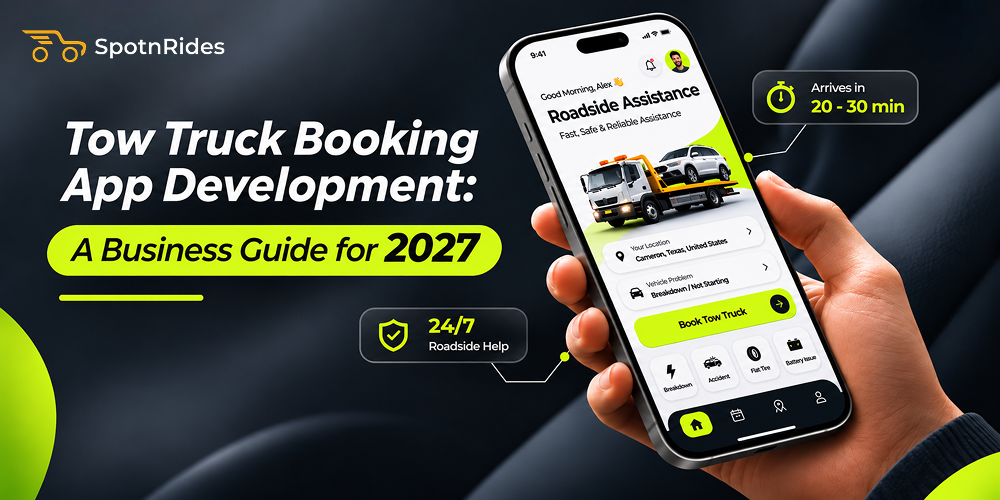
Tow Truck Booking App Development: A Business Guide for 2027
A vehicle breakdown can happen anywhere. Tyres might get flat, or engines might stop working. In this case, finding a reliable roadside assistance provider is a priority and challenging. For towing businesses, every service request represents an opportunity to attract customers and generate revenue. Managing towing requests via phone calls and manual dispatch is a huge task when the business scales. If requests are delayed due to poor communication and inefficient drivers, this leads to customer dissatisfaction and limits growth.
This is where a tow truck booking app development creates new opportunities for businesses.
The application brings customers, towing professionals, and administrators onto a single digital platform. Business owners can simplify service bookings, coordinate fleets, and manage roadside assistance operations efficiently.
Are you planning to digitize an existing towing company or launch a new on-demand roadside assistance business?
Then this blog is for you. Explore the essential features, development process, and business models in 2027.
Why Should Businesses Invest in Tow Truck Booking App Development?
The first reason is people’s changing behavior. They do not want to wait too long to acquire a service. This is the reason why investing in tow truck booking app development is a good idea for businesses. For towing businesses, adopting a digital booking platform offers several business advantages.
- Customers can discover and request towing services via mobile applications rather than relying on phone-based enquiries.
- Monitor driver availability and assign service requests based on location, vehicle type, and workload.
- Automate booking confirmations, driver notifications, payment processing, and service updates.
- Generate income through booking commissions, service charges, subscriptions, and business partnerships.
- Offer transparent pricing, driver details, live tracking, and convenient payment options.
Essential Features to Include in a Tow Truck Booking App
A successful towing platform requires more than a booking interface. It needs connected applications that support customers, drivers, and business administrators.
- Quick Registration
- Service Selection
- Location Detection
- Multiple Payment Options
- Booking History
- Driver registration
- Document verification
- Request acceptance or rejection
- Earnings reports
- Manage customer accounts
- Verify drivers
- Monitor fleet locations
- Assign bookings
- Configure service pricing
- Handle customer complaints
How to Build a Tow Truck Booking App in 2027
In 2027, building a tow truck booking app will be simple with this guide. Building a towing platform takes planning and understanding of what you need to operate it. Here are some practical steps for developing a tow truck booking app.
Identify Your Target Market and Business Model
The first step is to determine who your customers are. Your audience may be comprised of car owners, insurance companies, auto dealers, rental car companies, or corporate fleet managers.
Then, decide the way in which your business will function. You can create a marketplace that allows you to bring independent towing careers and customers together, or you can create a marketplace that manages your towing fleet. This will impact your application structure, your feature needs, your pricing model, as well as your driver management process.
Define Application Requirements
Determine what the key functions are for each user type before you start coding. For instance, if you are starting a marketplace, you might need customer booking and driver onboarding, automated dispatch, and commission management. A well-established towing company might focus on fleet monitoring, employee scheduling, job allocation, and operational reporting. Identifying these needs in the beginning helps to avoid unnecessary tow truck app development costs and to ensure that the project is consistent with business goals.
Select the Right Technology Stack
The applications’ performance, scalability, and maintenance will be affected by your technology choices. Some of the following are commonly used technologies:
Frontend: Flutter / React Native (cross-platform mobile development).
Backend: Node.js, Python, or Java for application logic and server-side operations.
Application information: PostgreSQL or MongoDB.
Maps & Navigation: Google Maps or Mapbox for location services and route navigation.
Cloud Infrastructure: AWS, Microsoft Azure, or Google Cloud for infrastructure and hosting.
Payment Integration: Stripe or PayPal or appropriate local payment solutions.
Develop the Applications and Dispatch System
After the requirements and technology stack are decided, the development process starts.
All customer, driver, and admin apps should seamlessly integrate with each other via the centralized back-end. Once a customer makes a request, the system must identify appropriate drivers that are available and inform them. When the driver accepts the booking, the customer is notified and can track the vehicle. A well-designed dispatch mechanism is especially critical as it directly impacts service availability and response times.
Integrate Payments and Third-Party Services
Integrations make the platform more functional by connecting it with external services. Implement GPS tracking, navigation, payment gateways, push notifications, SMS alerts, and other necessary APIs. For businesses working with insurance providers or automobile service networks, additional integrations can support booking coordination and payment reconciliation.
Test, Launch, and Improve
Once the development is completed, test the platform across different devices and operating conditions. Pay particular attention to GPS accuracy, booking notifications, driver allocation, payment processing, application performance, and data security. Initially, start with a limited service area, onboard enough towing professionals, and collect feedback from initial customers. Use these insights to improve the platform before expanding into additional locations.
Custom Development vs. Ready-Made Tow Truck App Solutions
Another important decision is choosing the right development approach.
Custom development is building an application from scratch gives businesses complete control over the design, functionality, architecture, and future development roadmap. It is suitable for enterprises with specialized operational requirements and sufficient development budgets.
Whereas ready-made solutions or white-label towing platforms provide prebuilt customer and driver applications and an admin dashboard that businesses customize with their branding. They reduce the development time and initial investment, making them suitable for startups and existing towing operators looking to establish a digital booking platform.
Business Strategies to Grow Your Tow Truck Booking Platform
Launching an application is only the beginning. Sustainable growth depends on how effectively you manage operations and attract customers. Consider these strategies:
- Build a Reliable Driver Network: Partner with verified towing professionals across your service locations to improve booking availability.
- Establish Strategic Partnerships: Collaborate with insurance companies, automobile dealerships, vehicle rental businesses, and fleet operators.
- Introduce Flexible Pricing: Offer fixed charges, distance-based pricing, and additional service fees based on operational requirements.
- Use Performance Analytics: Monitor booking volumes, service completion rates, driver utilization, and customer feedback to identify improvement opportunities.
- Expand Gradually: Establish a strong presence in one location before entering additional cities or regions.
These strategies help businesses build a dependable service network while creating opportunities for long-term revenue growth.
Conclusion
The growing demand for convenient roadside assistance creates opportunities for towing businesses to modernize their operations and reach more customers. However, success depends on more than launching a mobile application. Efficient dispatch, reliable driver networks, accurate location tracking, and transparent service management are equally important.
With the right tow truck booking app development strategy, businesses can establish a digital booking channel, streamline fleet operations, and create a scalable roadside assistance platform.
Whether you choose custom development or a ready-made solution, start with SpotnRides. We provide a clear business model and features that address real operational challenges. The right technology investment can help position your towing business for sustainable growth in 2027 and beyond.
FAQ
It involves building a tow truck app development that is three connected apps: a customer app, an operator app, and a dispatch panel with advanced features.
Businesses like local towing companies, roadside startups, automotive groups, fleet businesses, and technology companies can start a towing business.
On-demand tow truck app development is a marketplace where a customer places a request; the platform finds nearby service providers and tracks the whole rescue process in real time.
About the author

Comments are closed.

