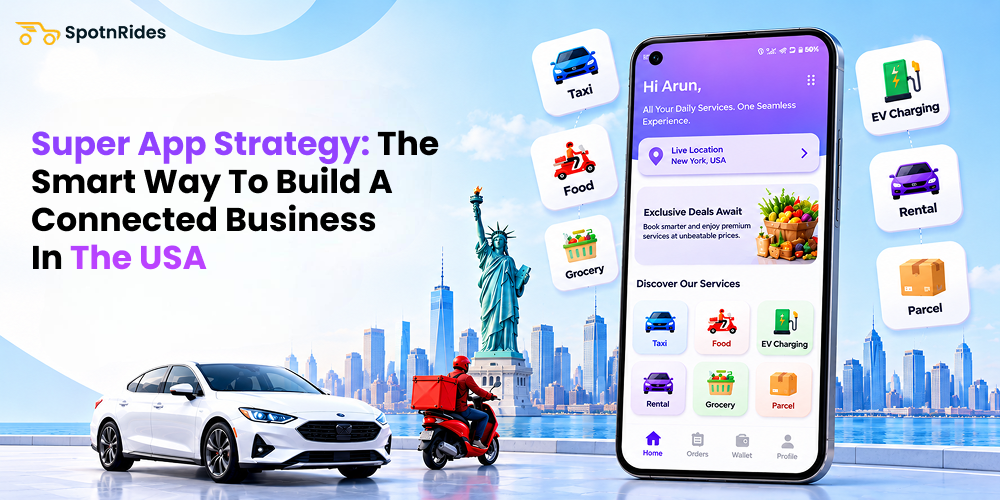
Super App Strategy: The Smart Way to Build a Connected Business in the USA
Businesses in the USA are looking for smarter ways to attract customers, increase revenue, and stand out in the competitive markets. Starting a smart business is not like providing a single service to customers. It should be offering multiple services to address customers’ issues.
A super app strategy is one such approach. It brings multiple services in a single digital platform. Instead of asking customers to download separate apps for different needs, businesses can offer multiple related services in a single app.
For example, consider a mobility business; it can offer ride booking, car rental, parcel delivery, and airport transfers through a single app. Customers get a more convenient experience, and the business gains new opportunities to generate revenue and build long-term relationships.
However, the success of the business depends on something more than adding several services to one platform. Before starting, businesses need to have a clear plan for choosing the services, understanding customer needs, managing operations, and creating a sustainable revenue model.
Why Are Businesses Exploring the Super App Model in the USA?
The US market has several established players in ride-hailing, food delivery, e-commerce, digital payments, and other on-demand services. According to Persistence Market Research, the super app market in North America is expected to hold 18% of the market share in 2026. This has created new opportunities for US businesses to connect services via a single platform.
On the other hand, customers are also familiar with digital transactions and expect a convenient and reliable experience. If a company runs a service and has an existing customer base, then they can introduce additional services to meet customer needs.
Now, let’s consider this example: a car rental business. Here, the company initially starts with vehicle reservations and later adds several services. The following are some ideas for additional services for car rental businesses a vertical super app to integrate into their platform:
- Airport transfers
- Chauffeur services
- Travel bookings
- Vehicle delivery and more
Businesses can also integrate multiple services with a horizontal super app type, where they can offer services from various categories, such as: if a company starts with a food delivery platform, they can add the following services:
- Grocery delivery
- Car rental booking
- Taxi booking
- Parcel delivery
- Identifying EV charging stations and more
Customers can access these services via one account, whereas the business can create multiple revenue streams by creating separate apps for separate customer experiences. A successful strategy starts with a clear question: which services address the customer needs? The answer should guide the platform’s development.
Super App Strategy: How Can Businesses Generate Revenue?
Businesses can generate money via various revenue models. A strong super app strategy connects customer convenience with a practical super app business model. In a super app, businesses can combine several revenue streams based on services and target audience.
1. Commissions and Transaction Fees
The business owners earn commissions from the customers using the services or purchasing products via the super app platform. Also, businesses charge the participating stores a commission for every completed order. Further, a mobility platform can also earn a service fee for every eligible booking. The rate and structure should reflect the operating costs, partner agreements, and customer expectations.
2. Subscriptions and Loyalty Programs
Customers choosing subscriptions benefit from reduced delivery fees, priority bookings, exclusive offers, or discounts across the provided services. For example, a business serving customers via grocery delivery and local transportation could offer a membership that rewards repeat use. The plan should provide enough value to encourage renewals without reducing profitability.
3. Advertising and Sponsored Listings
Vendors or shop owners participating in the platform offer paid promotional placements. Restaurants, retailers, and local business owners pay a certain amount to feature their product and reach relevant customers. Sponsored listings should remain clearly identified and relevant to users. Too many promotions make the app difficult to navigate and sometimes weaken customer trust.
What Can Businesses Learn From Careem, Grab, and Gojek?
Here are some existing super app examples. These businesses show how the platform has expanded from its original service and keeps customer needs at the center of its strategy.
- Careem initially started with ride-hailing and later expanded its services to food delivery, grocery delivery, and payments in its operating markets. This business development shows how the core services can create opportunities to open up with the related offerings.
- Grab super app strategy connects services like transportation, food delivery, and financial services across several Southeast Asian markets. Its approach highlights the importance of local partnerships and adapting services to regional needs.
- Gojek starts with on-demand services in a broader platform connecting customers with various services such as transportation, delivery, and other everyday services.
Using these examples, US businesses can easily understand the super app model and start their own without copying their entire models. The right approach is to identify what the customer wants, build and expand the services when there is sufficient demand.
Which US Industries Can Benefit From a Super App Strategy?
It is not that every business needs a super app. The strongest opportunities come from industries where customers already use multiple related services.
Mobility and Transportation
Under the mobility and transportation industry, taxi operators, chauffeur companies, and car rental businesses can connect ride booking, vehicle reservations, airport transfers, and corporate transportation. These services might help businesses to serve different customer needs on one platform.
Food and Grocery Delivery
In the food and grocery delivery industry, business owners can connect restaurants, grocery stores, convenience retailers, and local delivery partners. A multi-vendor model can give customers more choices and help businesses earn through commission and delivery fees.
Retail and Local Commerce
Retail businesses can combine product discovery, online ordering, local store delivery, loyalty programs, and customer support. This model helps local merchants to reach customers via a shared digital platform.
Tourism and Hospitality
The travel businesses connect accommodation reservations, airport transfers, vehicle rentals, tours, and local experiences. This can be mainly useful for businesses serving visitors who prefer to arrange several parts of a trip in one place.
Technology and Compliance Considerations for the US Market
The important strategy of a super app is the technology decisions. As it influences how the super app can grow. Moreover, businesses should also focus on the following areas before development begins.
Flexible architecture: Adding services is easier due to a modular platform. Other components like user accounts, notifications, and reporting can be shared between separate service modules.
Payment integration: Integrating the payment process with compatible credit cards, digital wallets, and other means of payment can enhance the shopping cart experience. The selection should align with the target audience, service type, and the needs of the payment provider.
Personalization and AI: AI can be used to make personal suggestions for relevant services based on customer activity and preferences. AI-powered support can provide answers for the routine questions, while demand forecasting supports operational planning. These features can be introduced as they offer measurable value for business growth.
Security and privacy: Businesses must have proper access control, data security, safe payment processing, and transparent privacy policies. There may be differences in requirements in the United States depending on state and business activity. For instance, California’s laws about privacy could pertain to a specific enterprise, and payment processing could consist of PCI DSS security requirements. Businesses should evaluate their particular responsibilities prior to launch.
Scalability and reliability: The platform should be prepared to handle changes in traffic, transactions, and service demand. Monitoring, testing, backups, and reliable infrastructure are important as the customer base grows.
Build a Connected Business With the Right Super App Strategy
Finally, a well-planned super app strategy helps US businesses to connect all related services and improve customer convenience. The app further explores new revenue opportunities. The significant point is to expand the services with a clear purpose rather than just adding features to make it big.
If you are planning to start a multi-service business, start by identifying your customers, selecting services, building the super app, choosing your revenue model, and then plan for long-term growth.
Choose the right super app development partner like SpotnRides to build your flexible and customizable platform. Ensure your goal is to build one connected experience that creates value for customers and sustainable opportunities for the business.
Build your platform, attract customers, expand service, increase revenue, scale your platform.
Ready to Build Your Own Super App?
Turn your business idea into a connected platform with multiple on-demand services. Build a customizable super app with SpotnRides that fits your business goals and creates new growth opportunities.
Get Your Super App Demo Today!
FAQ
A super app strategy is a business plan for combining multiple services into one digital platform. It helps businesses offer connected services, improve customer convenience, and create additional revenue opportunities.
A super app can generate revenue through booking commissions, delivery fees, subscriptions, advertising, and partnerships with service providers. Businesses can choose revenue models based on their services and target customers.
Industries such as transportation, food delivery, grocery delivery, retail, tourism, and local services can benefit from a super app by offering multiple related services through one platform.
About the author

Comments are closed.

