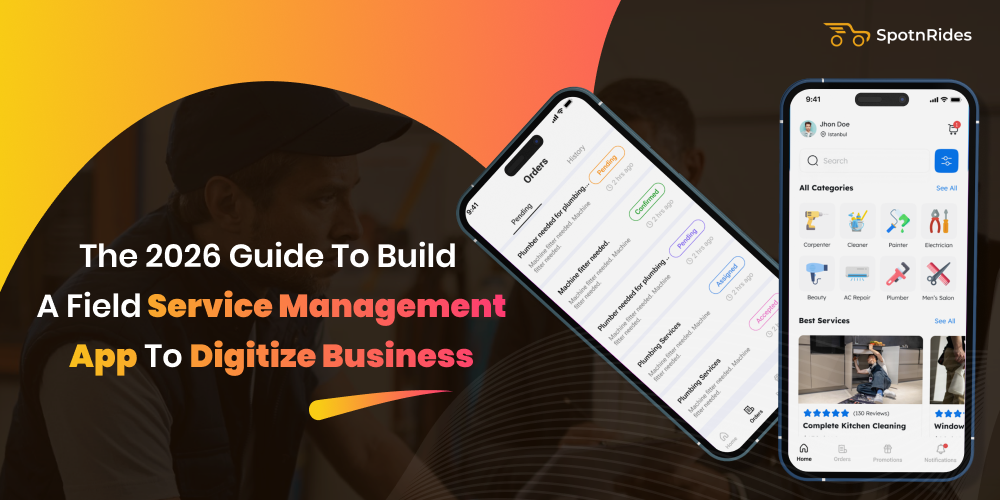
The 2026 Guide to Build A Field Service Management App to Digitize Business
Coordinating resources to conduct field service operations and managing the mobile workforce is a challenging task for business owners. The business is profitable as it generates revenue from serving more than 70% of service organizations. The use cases of field service management expand beyond home services to include utilities, healthcare, maintenance, and telecommunications. So, the need to build a field service management app rose to support different industries.
Field technicians, dispatchers, and business owners require a ready-made app to navigate through a pile of schedules, rising customer expectations, and a changing technology adoption scenario. Hence, they are thrilled to work on a proven framework to boost productivity, meet elevated customer expectations, and modernize operations. Follow our guidance to develop and launch your own field service management app.
What is a Field Service Management (FSM) app?
A field service management app is a digital tool that enables businesses to automate job scheduling, track field technicians, manage inventory, and monitor every operation. Having a modern, white-label field service management app helps digitize the entire business to offer standard workflows for technicians. Efficiency is embedded in every process from task allotment to exceptional service delivery. Primarily, this platform is used by entrepreneurs in plumbing, HVAC, telecommunications, and utilities.
The core features of the field service management app include:
- Automated Scheduling: The app automatically matches the customer with the right field technician based on availability, location, and their experience or skill set.
- Live GPS Tracking: Customers track the real time location of field teams using the tracking system, which helps improve response times.
- Route Optimization: Technicians can reach the customer’s location on time and meet the service requirements using the handy tool.
- Service Requests: New service requests appear on the field technician app, which makes accessing service history and updating status easy.
- Inventory Management: Technicians can deliver an exceptional service by tracking the inventory from the app and updating the tools.
- Digital Payment Support: Customers can pay for the field service directly from the app using their credit/ debit card, wallets, or a local payment gateway.
- Analytics & Reporting: Companies can view real-time reports on technician performance, average response times, and revenue for field services.
What Challenges Do Businesses Face in Field Service Operations
Field service business owners often suffer from inefficient job routing, a lack of work coordination, outdated data systems, and skill gaps. Errors in payments and poor inventory management can slow down your business processes. Discovering the challenges early will help you address them on time and boost efficiency.
Losing Track of Job Status
Businesses find it hard to locate technicians and know their job statuses after the dispatch without a tracking system. This inadequate system creates a disruption in their business processes and leaves them unsure of the outcomes.
Solution: The field service management app informs business owners of the status of the service, digital work orders, payments, and other essential information.
Uneven Skill Set of Technicians
Typically, manual methods of assigning technicians for a task can be inaccurate. In extreme cases, the technician may lack the desired skill set to execute the service to their full potential. And when this happens occasionally, it affects the brand image of your home service business or any other field service-oriented business among customers.
Solution: The time-saving, automated service matching engine makes accurate job allocation for technicians and helps businesses assess their performance.
Operational Constraints
Technicians may miss their service requests, understand the customer preferences, or arrive late at the customer’s location. These bottlenecks in operations lead to poor customer experience. A communication gap can cause a rise in the number of frustrated clients.
Solution: The centralized field service management app helps create clear communication, work on every service request, and improve operational efficiency.
Steps to Build A Field Service Management App to Boost Productivity
With a forecasted growth of USD 9.87 billion, the field service management market continues to be one of the most lucrative businesses across the world. Field service management solutions become the turnkey software solution for businesses to optimize their workflows and enhance customer experience. The process to build a field service management app requires business owners to follow strategic steps for a successful launch.
1. Define Clear Business Goals
Before starting development, take your time to discover the market gaps in the field service management and your actual struggles. Focusing on what disturbs your field service business will help you develop an app that directly solves those concerns. For instance, if your business struggles with dispatching, you can invest in a technology that can upgrade the dispatching processes.
Long-term goals help you with a clear direction for your field service operations and the digital tool that can improve your success rates.
2. Choose A Development Approach
The choice of the development approach is critical; it depends on your budget, integration needs, and technologies. A custom-built field service management app consumes lengthy development cycles, high upfront costs, and risks, but offers higher stability and performance. A ready-made field service app has its own perks, such as customization, cost efficiency, quick launch, and brand recognition.
A trusted development partner like SpotnRides executes the development approach and offers a ready-made solution that aligns with your business objectives.
3. Analyze and Finalize The Features
Defining the core features for the field service management app should be the next essential step. The set of features should fit into your business requirements and elevate the overall processes. For technicians, the must-have features include job requests, intelligent routing, in-app communication, offline functionalities, and payouts.
The customer app should have an intuitive interface with real-time dispatch, scheduling, and other on-demand features for seamless usage.
4. Choose the UI/ UX & The Tech Stack
The way your app looks on a customer’s mobile screen matters the most. They should be able to navigate the platform without friction and access different options. Finding the right technology stack is important as it impacts stability, performance, scalability, and integrations. Discussing this aspect with your technology provider will help you launch with confidence.
An enhanced user experience and a strong suite of technologies will cause the final output to meet your needs.
5. Focus on Agile Development
Instead of piling everything, you should break the development processes into management sprints. Creating milestones, observing the development process, and testing the app after development make it easier to ensure long-term stability. Continuous feedback to your technology provider will help you keep track of the entire process.
6. Launch & Scaling Business
Once everything is ready, it’s time to test the app to confirm that it can handle any of the service requests. Besides, the technology provider will launch the app on the intended platform by following the necessary app store guidelines. Even after the launch, the usability of the app should be monitored for steady results.
Conclusion
A field service management app has been found to improve field service operations, boost customer retention, and improve productivity. In 2026, business owners realize this shift and are gradually looking for ready-made solutions that can resolve their pain points and offer them improved outcomes. Comparing the business benefits, they have repeatedly chosen SpotnRides for their field service management apps to build a path for success.
FAQ
Modern FSM apps include AI-powered scheduling, GPS tracking, real-time dispatching, offline mobile access, customer portals, inventory management, IoT integration, analytics dashboards, and automated invoicing.
The development cost of a field service management app varies depending on the basic or advanced version, UI/UX, features, and other customizations for an enterprise-grade platform with AI, IoT, and advanced integrations. Get your custom quote from SpotnRides.
Industries such as HVAC, healthcare, telecom, construction, plumbing, utilities, and maintenance services benefit significantly from FSM software because it improves technician productivity, customer experience, and operational efficiency.
Businesses are moving away from outdated FSM systems to adopt AI-driven, mobile-first, and cloud-based solutions that offer real-time visibility, automation, predictive maintenance, and seamless customer experiences.
About the author

Comments are closed.