The Role of Telematics in Modern Car Rental Fleet Management
Car rental businesses produce a large amount of data every day. This data is more valuable for managing a successful and effective mobility business. Business owners want all data to ensure the vehicles are available without delay when customers need them, maintenance is done on time, and every asset contributes to business revenue. However, managing these manually is difficult when the operations expand.
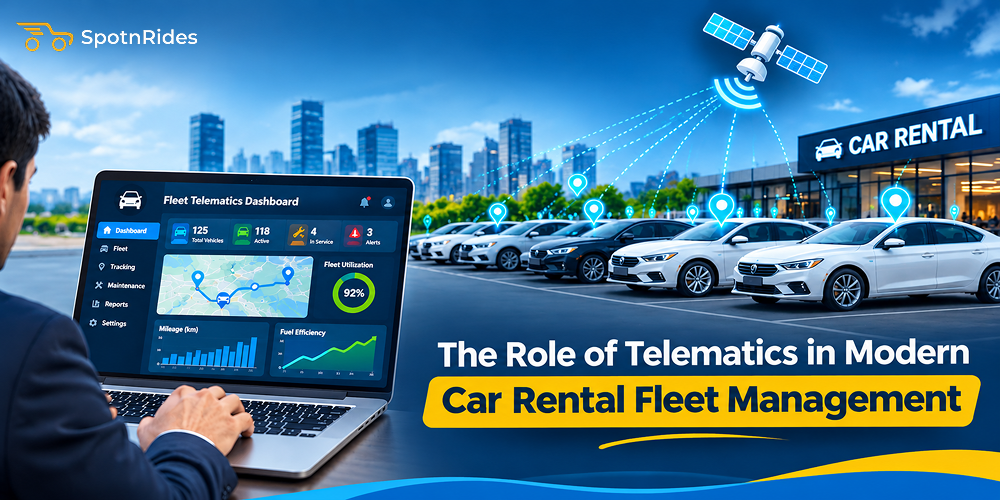
This is where telematics technology comes in. By collecting vehicle data via GPS devices, onboard sensors, satellites, and connected systems, telematics gives rental operators better control over their fleet operations. When telematics is integrated into car rental fleet management software, it helps businesses to make decisions effectively, reduce operational inefficiencies, and improve vehicle utilization.
Let’s explore how telematics is transforming car rental fleet management and why it is significant for businesses.
How Telematics is Transforming Car Rental Fleet Management
Before entering into the context, let us first understand what telematics is. Telematics uses both telecommunication and information processing systems to send and receive data. Car rental companies combine GPS tracking, satellites, sensors, or other cellular connections to turn real-time movement and mechanical data into actionable insights. Here are some key points explained on how telematics helps car rental fleet companies to manage their fleets.
Gain Complete Fleet Visibility with Real-Time Tracking
Vehicle location is important for managing a rental business, mainly if the business is operating across multiple branches. Without knowing the accurate location information, fleet managers cannot monitor vehicle movements, allocate vehicles to customers, and coordinate returns. Telematics-powered GPS tracking provides real-time visibility into vehicle locations and movement patterns. Business owners can monitor whether the vehicles are rented, idle, returning to the branch, or moving outside authorized areas.
For example, if a customer takes a rental vehicle outside the geographical zone, the car rental fleet management system can generate an alert to the manager. Similarly, the location data helps to coordinate vehicle pickup and returns effectively. Integrating GPS tracking with car rental management software brings all vehicle information and booking activities together, allowing operators to manage their fleet via a centralized platform.
Reduce Vehicle Downtime Through Predictive Maintenance
Unexpected vehicle breakdowns can interrupt the booking schedules, affect customer trust, and increase expenses for repairs. When a vehicle is unavailable after the booking is confirmed can result in losing the customers. Telematics here takes a proactive approach to vehicle maintenance by collecting information like engine performance, diagnostic alerts, and vehicle usage patterns.
Fleet managers use this information to identify mechanical issues and schedule inspections before they develop into major problems. For instance, when the vehicle approaches the service mileage, the system can send an alert or reminder for maintenance. Similarly, the trouble codes can help maintenance teams investigate engine-related issues before assigning the vehicle to customers. When these are connected to fleet management software for car rental, operators can maintain service records, monitor maintenance schedules, and track vehicle availability.
Improve Fleet Utilization with Vehicle Usage Analytics
Purchasing additional vehicles is not the smart choice to increase revenue. Sometimes businesses might have enough vehicles but lack the insights needed to utilize them. Telematics provides the required information about vehicle usage, including travel distance, idle time, movement patterns, and operating hours. This information is utilized by the rental operators to understand how to book their assets effectively.
For example, if certain vehicles receive more bookings in one location, managers can adjust the fleet allocation to meet the demand. Also, the vehicles that are unused can be relocated to other branches with higher booking activity. Combining telematics insights with rental booking data identifies the unused vehicles and helps to make better fleet expansion decisions.
Strengthen Driver Safety and Vehicle Security
An important consideration for every rental company is vehicle safety. As vehicles are monitored by different customers with varying driving habits, proper monitoring risk driving behavior and vehicle usage should be implemented. Telematics systems can capture driving information like rash driving, braking, and excessive idling. Fleet managers can review these platforms to identify potential risks and establish better vehicle usage policies.
Geofencing is another layer of security by allowing businesses to define geographical boundaries for vehicle movement. In addition, certain connected vehicle systems can provide collision alerts and vehicle health notifications, depending on the installed hardware and integration capabilities.
Optimize Rental Operations with Data-Driven Decisions
An evolving car rental business generates information from multiple activities. This includes reservations, vehicle returns, maintenance, customer usage, and payments. Managing these details makes it difficult to understand overall business performance. Telematics adds a valuable data source by providing information about vehicle mileage, movement, utilization, and operating conditions. These insights can be leveraged with car rental management software to inform better business planning.
For example:
Vehicle allocation: Identify locations that need additional vehicles based on usage patterns and booking demand.
Plan maintenance: Schedule vehicle maintenance based on mileage records and vehicle health alerts.
Cost tracking: Review trip data, fuel usage, and operations to look for ways to save money.
Vehicle location: Use location data for better vehicle pick-up and return arrangements.
Performance analysis: Link vehicle use and booking to assess fleet productivity.
How Car Rental Management Software Complements Telematics
The data collected from telematics is valuable to the vehicle, but isn’t always enough to optimize fleet management. Rental companies also require a platform to tie vehicles and insights to regular business operations.
This is where car rental management software comes in handy; it integrates reservations, vehicle availability, customer data, payment processing, and fleet management into a single platform.
The platform can be part of a compatible telematics solution to assist rental companies with:
- View vehicle location alongside rental and booking information.
- Monitor vehicle availability and maintenance status.
- Organize service schedules using mileage-based updates.
- Manage vehicle assignments across multiple branches.
- Access operational information for better fleet planning.
Businesses looking to grow and expand can benefit from telematics when coupled with a centralized rental management system, providing an organized base for handling more vehicles and customer demand.
Wrapping Up
By improving fleet visibility, optimizing vehicle performance, and integrating the right car rental app development features for operational control, car rental companies are increasingly adopting telematics. Connected vehicle data can help operators discover inefficiencies and make better use of assets in real-time, through predictive maintenance, by analyzing how assets are being utilized, and by monitoring driver safety.
However, the true benefit comes by connecting telematics insights with day-to-day rental activities. SpotnRides, the premier car rental app development company, integrates fleet management software into car rental solutions to improve efficiency and security. With the right software infrastructure and compatible telematics integrations, rental operators can build a more efficient, scalable, and data-driven car rental business.
FAQ
Telematics helps rental businesses monitor vehicle locations, mileage, usage patterns, and vehicle health. These insights support better maintenance planning, fleet utilization, security, and operational decisions.
Telematics provides mileage information, diagnostic alerts, and vehicle performance data. Rental operators can use these insights to identify maintenance requirements, schedule servicing, and avoid unexpected repair expenses.
Yes, compatible telematics devices and APIs can be integrated with car rental management software to connect vehicle data with bookings, maintenance schedules, vehicle availability, and fleet operations.
About the author

Comments are closed.