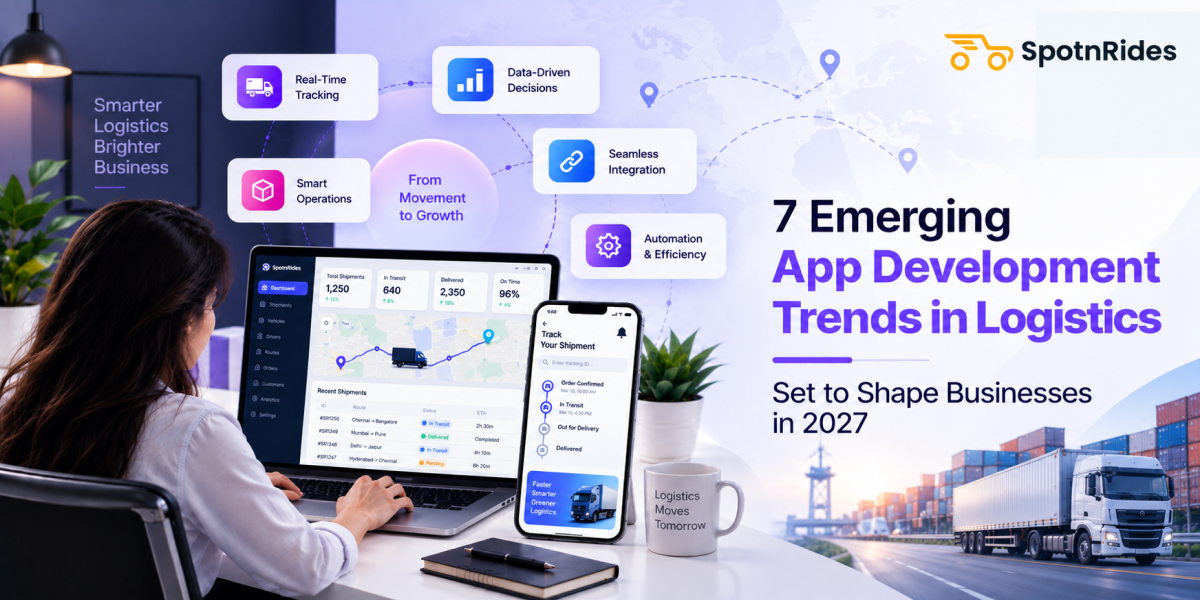
7 Emerging App Development Trends in Logistics Set to Shape Businesses in 2027
The logistics and supply chain environment transformed drastically in the first quarter of 2026 and is expected to change further in 2027. Logistics app development is evolving beyond standard features toward industry-specific solutions that enhance supply chain visibility, automate workflows, improve customer loyalty, and optimize routing for better operational results. Fleet operators, hyperlocal startups, and warehouse managers should learn app development in logistics, including AI and predictive analytics and IoT integration, to secure a future in this transformative era.
When creating a mobile-first ecosystem, this blog will empower you to predict future trends and develop a logistics app that can help sustain your business. With expert guidance, we have detailed the trends and highlighted how a reliable, on-demand app provider can support your digital transformation.
When Did Logistics Systems Begin to Transform
Logistics app development became a leading service designed to create custom and ready-made logistics apps that support transportation, inventory tracking, delivery management, and warehousing. Post-pandemic, businesses began to notice an immediate demand for supply chain resilience, real-time tracking, and contactless delivery. And then, everything came down to redefining the way goods are moved.
Ever since digital shifts began to surface, companies were convinced they should develop mobile and cloud-based platforms to compete well. This happened from 2021 to 2025, when businesses familiarised themselves with the new technologies.
Today, logistics is rapidly shifting toward AI-driven and highly specialized solutions that make supply chain operations more intelligent, efficient, and responsive. Building on the rise of connected systems, logistics software helps businesses unify orders, carrier data, and warehouse operations within a single, streamlined ecosystem.
7 Logistics App Development Trends Businesses Should Watch in 2027
Advancements in the logistics app space show that businesses need to adopt modern technology to cut costs, see better shipment tracking, and make data-driven decisions. By integrating cutting-edge technologies, businesses can establish clear communication between shippers and drivers. Through our experience working with logistics businesses, we’ve gained firsthand insights into the changes shaping the industry and the technologies driving them.
AI-Driven Logistics & Machine Learning Automation
There is a great possibility for Artificial Intelligence to play a central role in logistics operations. Machine learning models and AI are closer to precision in predicting delivery times, demand surges, and fuel requirements. The apps can analyze real-time traffic, vehicle capacity, and seasonality to calculate the shortest delivery paths in real time. Leveraging computer vision, logistics apps can help personnel instantly scan packages, automate bills of lading, and flag product damage sooner.
Options such as algorithm-based dynamic rerouting, driver analytics, and behavioural monitoring can offer necessary support in managing logistics businesses.
Cloud-Powered Logistics Infrastructure
Emerging cloud architecture trends such as serverless computing, edge computing, and analytics integrations help optimize operational agility and reduce latency. The cloud architecture acts as a scalable digital backbone that enables businesses to manage seasonal demand spikes and operations across multiple locations and devices. With regards to data accessibility, the infrastructure allows rapid updates to the logistics apps and offers live dashboards for inventory tracking.
The system creates a unified interface where partners, suppliers, and carriers collaborate and share updates instantly.
Contactless & Automated Last-Mile Delivery
A major change in last mile delivery is the increasing preference for minimal human contact and operational speed. Supporting the growing trend, modern logistics apps feature electronic proof of delivery (ePOD), smart dispatch and routing, autonomous hardware integration, and real-time customer transparency. These automation functionalities help businesses improve safety and digitize delivery operations. The app sends live tracking information to the end users to maintain real-time customer transparency.
Especially in the last-mile delivery market, these automated deliveries are expected to boost the segmental growth in 2027.
Regulatory Compliance & Industry Standards
Maintaining compliance standards is a significant app development trend in logistics that businesses should treat with complete attention. Ensure the app providers embed data protection protocols like GDPR and CCPA and safety rules in the app architecture to safeguard user and customer data. When developing a logistics app, businesses should ensure it complies with relevant transportation and safety standards, including applicable U.S. Department of Transportation (DOT) regulations.
Modern logistics apps give granular permissions and enhance the maintenance of activity logs to make them easier for audits.
IoT-Powered Logistics & Real-Time Tracking
Customers and businesses require a real-time tracking system to ensure that they can maintain transparency in overall processes. Monitoring shipments at different stages helps logistics businesses actively respond to delays and maintain smooth operations. IoT-powered logistics utilizes smart sensors to check vehicle health and alerts businesses on maintenance schedules to reduce repair costs and vehicle breakdowns. For sensitive products like medicine, the app helps monitor temperature and humidity through sensors.
IoT-enabled logistics apps work in such a way to streamline stock counts and timely replenishment.
Blockchain-Enabled Security & Data Transparency
Entrepreneurs integrate blockchain into their supply chain to improve transparency and enhance efficiency in logistics. Its tamper-proof record keeping enables businesses to prevent document fraud and cargo theft. This app development trend in logistics uses smart contracts to automate payments, approvals, and customs clearances. Especially in sectors such as food, blockchain-enabled apps can create unique digital records that help verify product authenticity and traceability.
A distributed ledger stores shipment statutes, conditions, and other contracts to maintain security of supply chain tracking.
Sustainability & Carbon Footprint Tracking
Modern businesses are increasingly expected to build sustainability into their logistics operations. Apps can support this by using live telemetry data to estimate emissions based on factors such as vehicle size, fuel type, cargo type, and distance traveled. With real-time carbon tracking, businesses can identify emission-heavy routes, optimize operations, and simplify ESG reporting. Beyond reducing their carbon footprint, these improvements can help businesses control operational and facility-related expenses while progressing toward sustainability targets.
When developing a logistics app, businesses should work with a provider that can tailor sustainability features to their specific operational requirements and long-term environmental goals.
3 Leading Logistics Apps Shaping Markets Worldwide
A few platforms stand out for putting these trends into practice at scale. Studying how they operate gives businesses a useful benchmark before they map out their own logistics app.
Uber Freight
Uber Freight has built a freight marketplace that connects shippers directly with carriers, using algorithm-based matching to fill truckload and part-load capacity faster than traditional broker networks. Its strength lies in dynamic pricing and load-matching, giving shippers predictable capacity and giving carriers steadier lanes to run.
Flexport
Flexport has positioned itself as a digital freight forwarder, replacing paperwork-heavy customs and cross-border shipping processes with a single online dashboard. Importers can compare rates across ports, transport modes, and carriers, while the platform handles documentation, tariffs, and customs clearance behind the scenes.
Project44
Project44 runs a supply chain visibility platform connecting shippers to carriers across road, rail, ocean, and air, covering a very large global carrier network. Its real-time tracking and predictive insights help businesses spot delays before they escalate and keep every stakeholder, from warehouse teams to end customers, working off the same data.
How SpotnRides Prepares Your Business for the Future of Logistics in 2027
At SpotnRides, we help fleet operators, hyperlocal startups, and warehouse-driven businesses turn the trends above into working products rather than just concepts on a roadmap. Our team builds custom and ready-made logistics apps designed around real operational needs, whether it is dynamic dispatch, live tracking, driver management, and warehouse visibility. We integrate route optimization, demand prediction, and computer-vision-based package scanning directly into the app architecture, so businesses don’t have to bolt these features on later.
Our apps are built on cloud architecture that handles seasonal demand spikes and multi-location operations without slowing down, so the platform grows with the business rather than against it. We stay on after deployment to help fine-tune features, add sustainability tracking, or extend the platform as the business scales into 2027 and beyond.
Final Thoughts
Logistics in 2027 will belong to businesses that treat their apps as core infrastructure, not an afterthought. AI-driven automation, cloud-first architecture, contactless delivery, tighter compliance, IoT tracking, blockchain-backed transparency, and sustainability reporting are no longer optional add-ons; together, they define what a competitive logistics app needs to do. The businesses that get ahead in 2027 won’t necessarily be the biggest; they’ll be the ones that pick the right combination of these trends for their specific operations and build them in with the right development partner from the start.
FAQ
No. Even small and hyperlocal delivery businesses benefit from basic IoT features like vehicle health alerts and temperature monitoring, especially if they handle sensitive goods like food or medicine.
Timelines vary by complexity, but a ready-made or lightly customized logistics app can launch in a matter of weeks, while a fully custom platform with AI, IoT, and blockchain features can take several months.
A dedicated provider already understands transportation regulations, fleet workflows, and industry-specific pain points, which shortens development time and reduces the risk of missing compliance or operational requirements that a general agency might overlook.
About the author

Comments are closed.